How HablaYa tests language-learning features
A reproducible method for checking HablaYa voice, text, pronunciation, PWA, and practice flows.
What is the current test protocol?
Protocol dated August 15, 2026: choose one target language, learner level, and scenario. Complete five turns, record one concrete correction, and repeat the same task after 24 hours without changing the comparison conditions.
What should a tester observe?
Check time to start, voice and text availability, correction clarity, pronunciation behavior, follow-up continuity, saved vocabulary, progress state, mobile behavior, and contextual PWA installation.
How should tools be compared fairly?
Use the same language, level, task, device class, and number of turns for each tool. Note paywalls, sign-in requirements, errors, and unavailable features rather than inferring them.
What evidence is published?
No dated observed runs are published yet. The protocol and interface illustrations are not test results or user behavior. Anonymous aggregate usage statistics may be published only after a fresh export, with at least 100 users in every reported cohort and a privacy review that prevents individual inference.
What are the method’s limits?
Results describe a tested flow and date, not fluency, exam outcomes, retention, comparative superiority, or every learner experience. Model versions, prompts, devices, microphones, browsers, connections, accents, and account state can change a result.
Change log
August 15, 2026: clarified the five-turn protocol, added contextual install checks, labeled current observations as internal QA, and restated the 100-user privacy threshold for future aggregate evidence.
Recorded test runs
No observed runs have been approved for publication. Interface illustrations and the protocol above do not establish a pass or a learning outcome.
Q3 2026 evidence asset: the 3-minute correction-and-retry test
This controlled test checks whether a speaking tutor turns one learner response into a specific correction and an immediate retry. Repeat it with the same device, language, CEFR level, and prompt.
- Open a fresh practice in one target language and record the date, device class, browser, CEFR level, and whether sign-in or payment is requested.
- Say or type three sentences about your weekend. Save only the test prompt and product response; never capture a real learner identity or private conversation.
- Record whether the response identifies one specific grammar or pronunciation issue, preserves the intended meaning, and offers an improved sentence.
- Repeat the improved sentence and ask one harder follow-up. Record whether the correction remains available and the conversation stays on the same task.

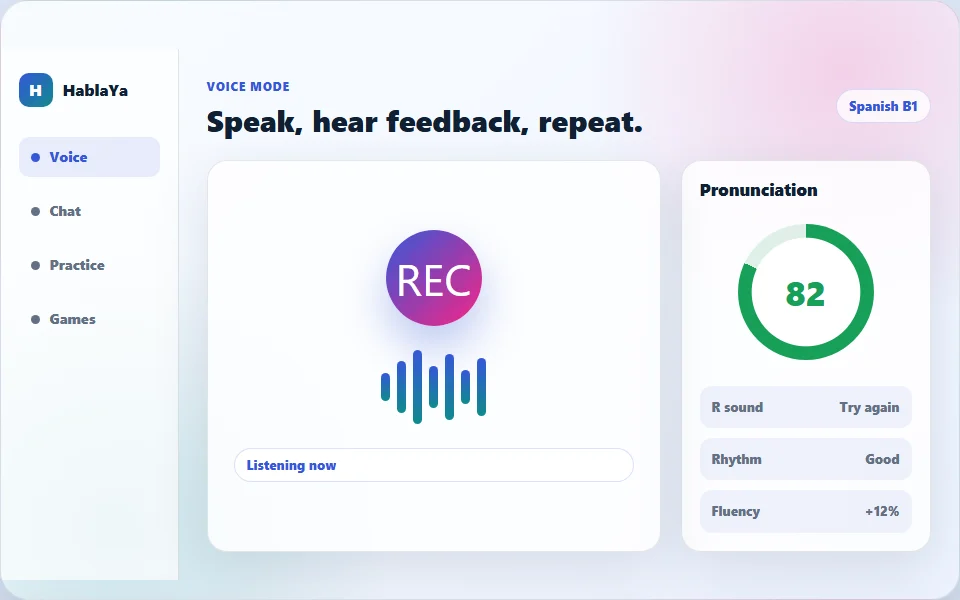
Finding rule: A pass requires the tester to identify one specific correction, retry the improved sentence, and continue the same task. A landing-page screenshot, event count, or generic encouragement does not prove correction quality.
Limitations: This product-flow test is not evidence of fluency, exam outcomes, or comparative superiority. Aggregate learner evidence is excluded until every reported cohort contains at least 100 users and passes privacy review.