
The best language learning routine: a practical speaking-first guide
A practical seven-day language routine with short conversation, vocabulary recall, an adherence log, and one repeated anchor task.
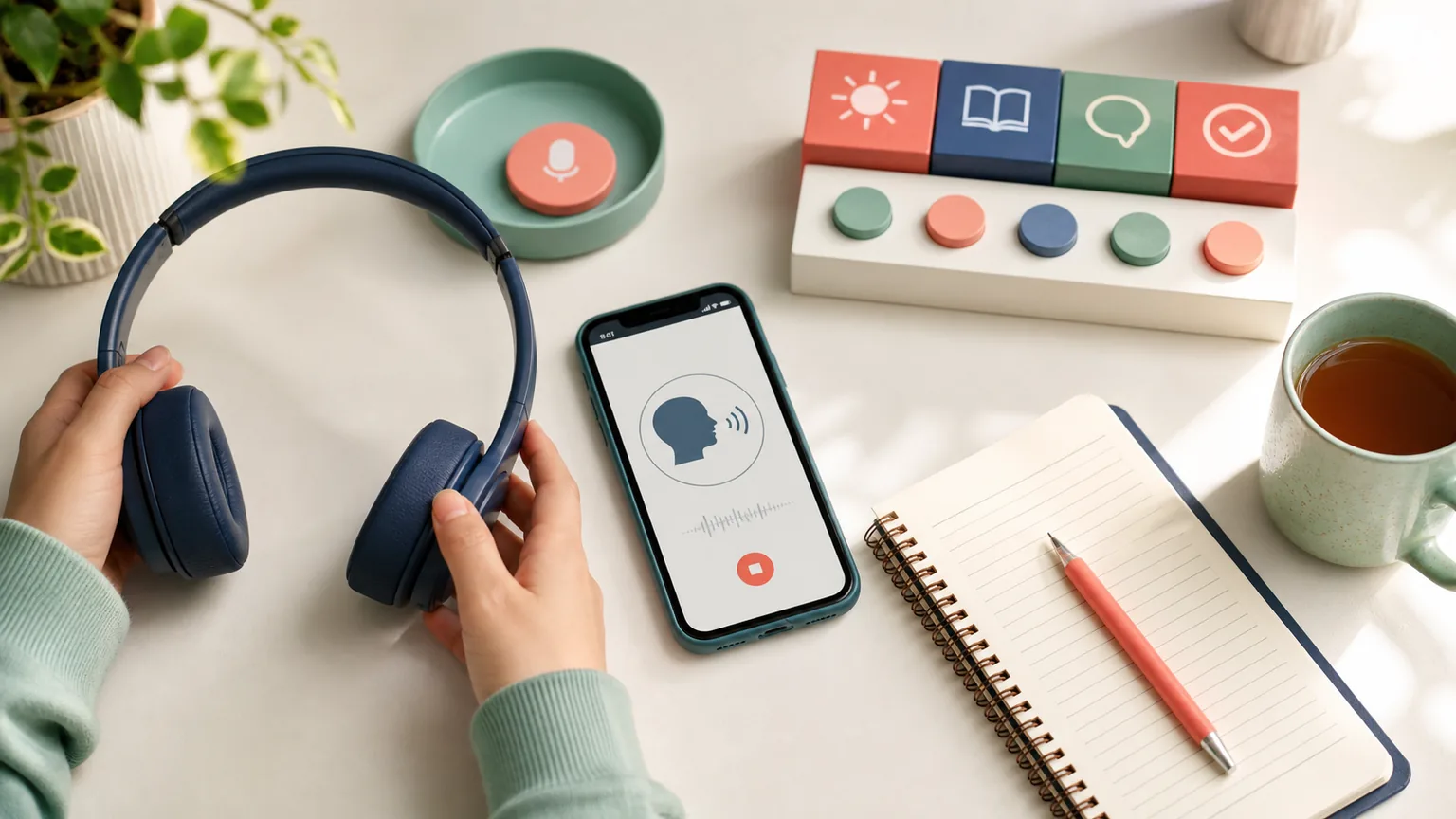
Plan seven days: ten minutes of conversation on days 1, 3, 5, and 7, plus five minutes of vocabulary recall on days 2, 4, and 6. Log planned and completed minutes without changing the plan midweek. Use the same short scenario on days 1 and 7. Record ease of starting, words recalled without hints, corrections reused, and missed-day reasons; do not convert these notes into a fluency claim.
The short answer
A useful routine alternates short speaking sessions with vocabulary recall, records missed days honestly, and repeats one anchor task on days one and seven without turning a one-week check into a fluency claim.
- Reproducible method: Define the seven-day schedule before starting, keep sessions short, and use a simple adherence log
- What to record: Record completion, start friction, recalled vocabulary, reuse of one correction, perceived effort, and recovery after a missed day
- Decision criteria: Judge a routine by adherence, manageable effort, retrieval practice, spaced return, useful feedback, variety, missed-day recovery, and whether it can continue without hidden payment pressure
What this search really wants
A useful routine alternates short speaking sessions with vocabulary recall, records missed days honestly, and repeats one anchor task on days one and seven without turning a one-week check into a fluency claim. Judge a routine by adherence, manageable effort, retrieval practice, spaced return, useful feedback, variety, missed-day recovery, and whether it can continue without hidden payment pressure.
Reproducible method
Define the seven-day schedule before starting, keep sessions short, and use a simple adherence log. Repeat one anchor task at the beginning and end under the same conditions.
What to record
Record completion, start friction, recalled vocabulary, reuse of one correction, perceived effort, and recovery after a missed day. Treat blank or missed entries as data, not failure.
Limits of the check
A one-week self-test is too short for claims about durable learning and is influenced by prior knowledge, motivation, sleep, and task difficulty. Self-ratings are not standardized scores.
Decision criteria
Judge a routine by adherence, manageable effort, retrieval practice, spaced return, useful feedback, variety, missed-day recovery, and whether it can continue without hidden payment pressure.
Reproducible examples
the best language learning routine:
- Plan seven days: ten minutes of conversation on days 1, 3, 5, and 7, plus five minutes of vocabulary recall on days 2, 4, and 6. Log planned and completed minutes without changing the plan midweek.
- Use the same short scenario on days 1 and 7. Record ease of starting, words recalled without hints, corrections reused, and missed-day reasons; do not convert these notes into a fluency claim.
Sources and testing
FAQ
Does this check prove that The best language learning routine: a practical speaking-first guide is best?
No. It is a reproducible product check, not a learning-outcome study. Use the recorded evidence and limitations to decide whether the tool fits your needs. A one-week self-test is too short for claims about durable learning and is influenced by prior knowledge, motivation, sleep, and task difficulty. Self-ratings are not standardized scores.
Practice now
Open HablaYa and start a real voice or text conversation. No credit card required.
Start practicing free